
Football
HUTCHINSON: Why the Red Bandanna Game is the greatest tradition in sports
On the 25th anniversary of September 11, Boston College honored Welles Crowther and reminded a new generation what it means to live for others


CHESTNUT HILL, MASS. – My legs were burning and I was short of breath as I sprinted up the staircase inside Alumni Stadium.
The coaches were using the elevator, rightly so, and kickoff was approaching. I took the stairs with several other members of the Boston College media because I did not want to miss the first snap.
At that moment, I was thinking only about football.
Then I looked down at the breast pocket of my jacket and saw the red bandanna folded inside.
I slowed.
Twenty-five years earlier, Welles Remy Crowther had faced a very different set of stairs. Mine led to a press box. His took him back toward people trapped inside the South Tower of the World Trade Center.
There is no comparison between those two climbs. That was exactly why the sight of the red bandanna stopped me.
Crowther was only 24 years old on Sept. 11, 2001. He was a Boston College graduate, a former Eagles lacrosse player, an equities trader and a trained volunteer firefighter.
After United Airlines Flight 175 struck the South Tower, Crowther reached injured survivors on the 78th-floor sky lobby. He covered his nose and mouth with his red bandanna, calmly directed people toward the building’s only viable staircase and helped them begin the long descent to safety.
Then he went back for others.
The National September 11 Memorial & Museum records that Crowther made three trips to the sky lobby, helping as many people as he could until the tower collapsed.
The people he saved did not know his name. They remembered the young man who appeared through the smoke wearing a red bandanna. Months later, when survivors described him publicly, his mother, Alison, recognized her son.
That small piece of red cloth allowed the world to learn what Welles had done.
Standing in the stadium stairwell, I thought about how young he was.
The football players preparing to take the field below were around his age, many of them younger. Nearly all were born after he died. Most of the students filling Alumni Stadium know Sept. 11 only through stories, classrooms, documentaries and memorials.
For them, it cannot be a personal memory. It must become an inherited responsibility.
That is why the Red Bandanna Game grows more important with time. History can become distant when the people learning it were not alive to experience it. A tragedy can be reduced to a date, a number, or a chapter in a textbook.
Welles’ story makes it human.
It asks a young person to consider what one 24-year-old man chose to do when other people needed him.
By the time I reached the press box Friday night, more than 40,000 people had filled Alumni Stadium for Boston College’s home opener and the 13th annual Red Bandanna Game.
Red bandannas appeared everywhere, tucked into pockets, tied around heads and draped across shoulders. Boston College wore its red-and-white paisley uniforms with “For Welles” across the players’ backs.
Rutgers carried its own tribute. Its uniforms honored the 37 university alumni lost in the attacks, and the words “NEVER FORGET” appeared on the Scarlet Knights’ football pants.
Welles was one of 22 members of the Boston College community who died that day. His story was at the center of the game, but it also helped the stadium remember the thousands of other lives that were taken and the families that have lived with those losses ever since.
Three days earlier, Welles had been posthumously awarded the Presidential Medal of Freedom, the nation’s highest civilian honor. With the game broadcast nationally, his alma mater had an opportunity to share his story with people far beyond Chestnut Hill.
I have attended the Red Bandanna Game every year and have had the privilege of covering it in person. Each game has carried meaning, regardless of the opponent or final score.
Friday felt different.
For the first time, the game was played on Sept. 11 itself. Exactly 25 years after the attacks, people across the country were pausing to remember where they were, whom they lost and how the world changed on that Tuesday morning.
From the press box, I watched Boston College meet the weight of that moment.
A U.S. Coast Guard helicopter flew over Alumni Stadium. Fireworks lit the night. A drone show unfolded above the field. Boston College created one of the most remarkable nights I have witnessed there, but its purpose was always clear: to honor those who were lost and show a new generation why Welles’ life still matters.
I remember the sadness of Sept. 11. I remember the disbelief. I remember confronting a question that still feels impossible to answer: How could human beings be capable of such evil?
Welles’ story gives us another question to consider.
How could a human being be capable of such courage?
His actions cannot make the tragedy less painful or lessen the grief carried by the families of those who died. Nothing can.
But that morning on 9/11/01 showed more than humanity at its lowest. Welles showed what it can be at its highest.
He did not know his actions would be remembered. He did not act because anyone was watching.
He knew more people needed his help, and he went back up.
That is why his story belongs in sports.
We watch sports because we are drawn to the human spirit. We watch people compete under pressure, trust one another, overcome adversity and discover whether they can rise beyond what they believed possible.
We do not honor Welles by comparing athletic courage to his sacrifice. We honor him by using the reach of sports to show what real courage looks like.
The Red Bandanna Game turns the attention and emotion of a packed stadium toward a question that matters long after the crowd goes home: How do we respond when another person needs us?
Boston College also needed the victory Friday night. The Eagles had lost their season opener and were playing in front of their home crowd for the first time. Their defense intercepted four passes, including Anthony Palano’s second interception with 1:46 remaining, and BC defeated Rutgers 28-21.
That result mattered to the players, coaches and supporters who had waited months to return to Alumni Stadium.
The deepest meaning of the night though did not become clear to me until long after the game was over.
Eagles Daily photographer Jack Garvey captured a young boy inside the stadium wearing a Red Bandanna football uniform and holding a handmade sign.
“I’M WELLES BECAUSE OF WELLES.”
The photograph spread quickly online. When I opened Facebook and began reading the comments, I found family after family sharing similar stories.
One person had named a son Welles because of Welles Crowther. Another had a grandson named after him. Others wrote about relatives and family friends who carried his name.
I kept scrolling, and I began to tear up.
Social media so often brings out anger, cruelty and division. That comment section was different. It was filled with people explaining how the life of someone they had never met had changed their families.
Those children were born years after Welles died. They will know him because someone chose to teach them about his courage. His example has traveled from survivors in the South Tower to families across the country and now to a new generation carrying his name.
Nothing good can balance the lives lost on Sept. 11 or erase the suffering that followed. But evil did not prevent people from answering it with extraordinary acts of love and service.
The photograph showed that those acts are still producing goodness 25 years later.
I had watched an entire stadium honor Welles. Still, the clearest proof of the tradition’s power was not in the sky or on the field.
It was a child holding a sign.
The Red Bandanna Game is the greatest tradition in sports because it does more than remember what Welles did. It carries his example forward. It teaches young people about the tragedy of Sept. 11 while showing them that the worst moment can still reveal the best within us.
It also reminds us that remembrance is not passive.
To remember Welles is to understand why he went back. It is to recognize the value of another person’s life. It is to become more willing to help, more capable of kindness and more committed to serving others.
At the beginning of the night, the red bandanna in my pocket made me pause on a staircase.
Hours later, that young boy’s sign helped me understand what the bandanna truly represents.
“I’M WELLES BECAUSE OF WELLES.”
One life teaching another how to live.
May we all become a little more like Welles because of Welles.
Mac Hutchinson, a columnist in Boston, is the Director of Digital Media for Eagles Daily, co-host of Eagles Weekly Podcast, and the founder of @BCFootballFans. He may be reached at mac@thinklyn.com


Today’s game against Virginia Tech was always going to be a messy one in Chestnut Hill, with 50 mile-per-hour windgusts and torrential downpours promised by the forecast. However, the Eagles certainly were not expected to hang in this game as well as they did, leading by as much as eight points, before Tech scored touchdowns on back-to-back drives in the fourth quarter, en route to their 21-14 victory over the Eagles.
Ted Roof’s defense, led by captains KP Price and Anthony Palano, held the Hokies to a remarkable three points in the first half. Virginia Tech ended the first half with five punts and a fourth-and-out. The BC-faithful could not have asked for a better start to the game defensively.
Unfortunately, as stymied as the Hokies’ offense was, the Eagle’s offense was worse, failing to score a single point in the first half. This afternoon, the Eagles seemed to have one key philosophy: trust quarterback Mason McKenzie to figure it out. And in the opening half, they did not find much success. The Eagles had as many punts as they had first downs in the half, and put up just 117 total yards as a team.
However, coming out of the locker room, McKenzie and the Eagles seemed to find a bit more of a rhythm offensively. On their second possession of the third quarter, McKenize connected with receiver Javarius Green for a 19-yard gain, before breaking off a 45-yard QB draw to the right. And the following play, McKenzie would scamper into the endzone, before Luca Lombardo’s extra point gave the Eagles their first lead of the game.
Roof’s defense remained steadfast, forcing a fumble and a turnover on downs on their two subsequent possessions, giving the Eagles possession with the lead going into the fourth quarter. What followed was the Eagles’ best series of the afternoon, a 9-play 67-yard drive highlighted by a 20-yard red zone connection between McKenzie and Dawson Pough. Then, McKenzie was able to get in the endzone for his second rushing touchdown of the day, giving the Eagles a 14-6 lead with 11 minutes to play.
Unfortunately, the Boston College defense ran out of steam, as the next six minutes of gametime saw them concede a gutting 10-play 80-yard touchdown drive, a two point conversion, and an overwhelming 76-yard rush to Tech’s Jeffrey Overton (featuring a potential missed hold on Palano). Overton’s score would ultimately serve as the nail in the coffin for the Eagle’s second loss of the young season.
While teh Eagles came into this game fresh off of an embarrassing 22-16 win against FCS opponent Maine, and were 14-point underdogs against the Hokies, their performance was marred by 89 penalty yards, a poor 2-13 third-down conversion rate, and only 13 non-McKenzie yards.
The Eagles will continue their season next Saturday with a road game against 22nd-ranked SMU. And while this afternoon’s performance against the Hokies was far from perfect, BC should have some positive momentum to build off of heading into Dallas.

By MIKE DiMAURO
Here’s one from your humble narrator whose vocation has been the written word for the last 35 years:
Don’t believe everything you read.
(I know. A ringing endorsement of the profession. But the truth is the truth.)
The latest example was The Athletic’s recent foray with publishing ballpark figures for every college football program in the Power Four (ACC, SEC, Big Ten, Big 12) that listed Boston College’s spending as last in the country, between $8 million and $13 million for the 2026 season.
After some research that went beyond coach Bill O’Brien’s assertion that the number was erroneous, I can confirm that O’Brien is correct. Campus sources support what O’Brien said last week and what athletic director Blake James said a while ago: BC is a full participant in revenue sharing, which is capped at little more than $21 million this year per school.
People Who Know tell me football receives roughly 75 percent of that. On revenue share alone, the number is more than $16 million, which would make it under the ACC average, per the Athletic, but more palatable. The average spending range in the ACC is between $21 million and $25 million, although 11 of the 17 teams spent about $25 million per year or less.
My concern with O’Brien’s comments last week came later in his weekly meeting with reporters. O’Brien said that the program must bolster third-party initiatives (the second way to compensate athletes after revenue share) to provide additional sources of compensation.
“Those things can come from different entities,” O’Brien said. “It can come from a business. It can come from a booster. We’re working through that as we move forward.”
It’s the “we’re working through that” part that sounded the siren.
“Working through that?” Shouldn’t this have already been worked through, given how most of the other Power Four universities seem to have this managed, at least based on how they’re spending?
And what became of Friends of the Heights, BC’s official third-party foray that was doing quite well? Friends of the Heights was instrumental in helping keep Zay Flowers, Ozzy Trapilo, Donovan Ezeiruaku and Quinten Post at BC, also while supporting a number of players on the 2024 Frozen Four hockey team and 2024 women’s lacrosse national championship team.
But it turns out that the entire NIL landscape now is more complicated than differential equations.
The two-minute drill version: Friends of the Heights, founded by loyal BC grads Joe Popolo, Brian Tusa, Sam Raia and Scott Mutryn (I call them BC’s Matthew, Mark, Luke and John), still exists but in a lesser role because of the terms of the 2025 House settlement that allowed revenue sharing (direct compensation).
All NIL deals must be cleared now by NIL Go, the official centralized disclosure and monitoring platform in Division I to report all NIL agreements. NIL Go has several requirements, not the least of which stipulates that the athlete’s compensation must be commensurate within his or her effort. In other words, $5 million for showing up and shaking a few hands for an hour to promote a product is verboten.
The problem is that many schools across the country are seemingly thumbing their nose at NIL Go, gambling on the fact that the entity simply doesn’t have enough investigators to nail the perpetrators. My sources tell me BC’s actions are proper – as we would hope – but it turns out Billy Joel is right: Honesty is such a lonely word.
So here’s where we are: If you are a BC grad or fan, you must understand that we really are all in this together. Never, ever in college sports history have fans and alumni assumed a bigger impact on their school’s fortunes. If you are a BC grad with a product or business that needs to be promoted, you should consider reaching out. Very seriously.
I can’t tell you how to spend your money. But if you really want to see BC succeed, you need to be part of the solution – and certainly not feed the moral outrage of moral opposition to NIL that I see repeatedly on social media. Straight up: If you aren’t helping, stop complaining.
BC, too, bears some responsibility here. I get that the new rules of the House settlement that approved revenue sharing in 2025 changed how Friends of the Heights can operate. There is also Van Wagner, the entity which sells sponsorships on behalf of the Eagles, who maintains relationships with many local businesses. I am asking BC, all the way up to Father Jack, to empower these two important groups in exponential ways. These are earnest folks who love BC and want the athletic programs to succeed.
Lest we forget: We saw the power of sports two weeks ago at Alumni Stadium when BC had a national media window all to itself – and hit one into the upper deck with the entirety of the Welles Crowther tribute. The nation got to see a full stadium in full throat saluting an American hero. It was a four-hour infomercial on what a special place we know Boston College to be. And the arm of the university responsible for such stupefying positive public relations: athletics. They’re important.
To reiterate: BC needs you. They need us. All of us. Now.
Mike DiMauro, a columnist in Connecticut, is a contributor to Eagles Daily and a member of BC’s Class of 1990. He may be reached at m.dimauro@theday.com or on X @BCgenius
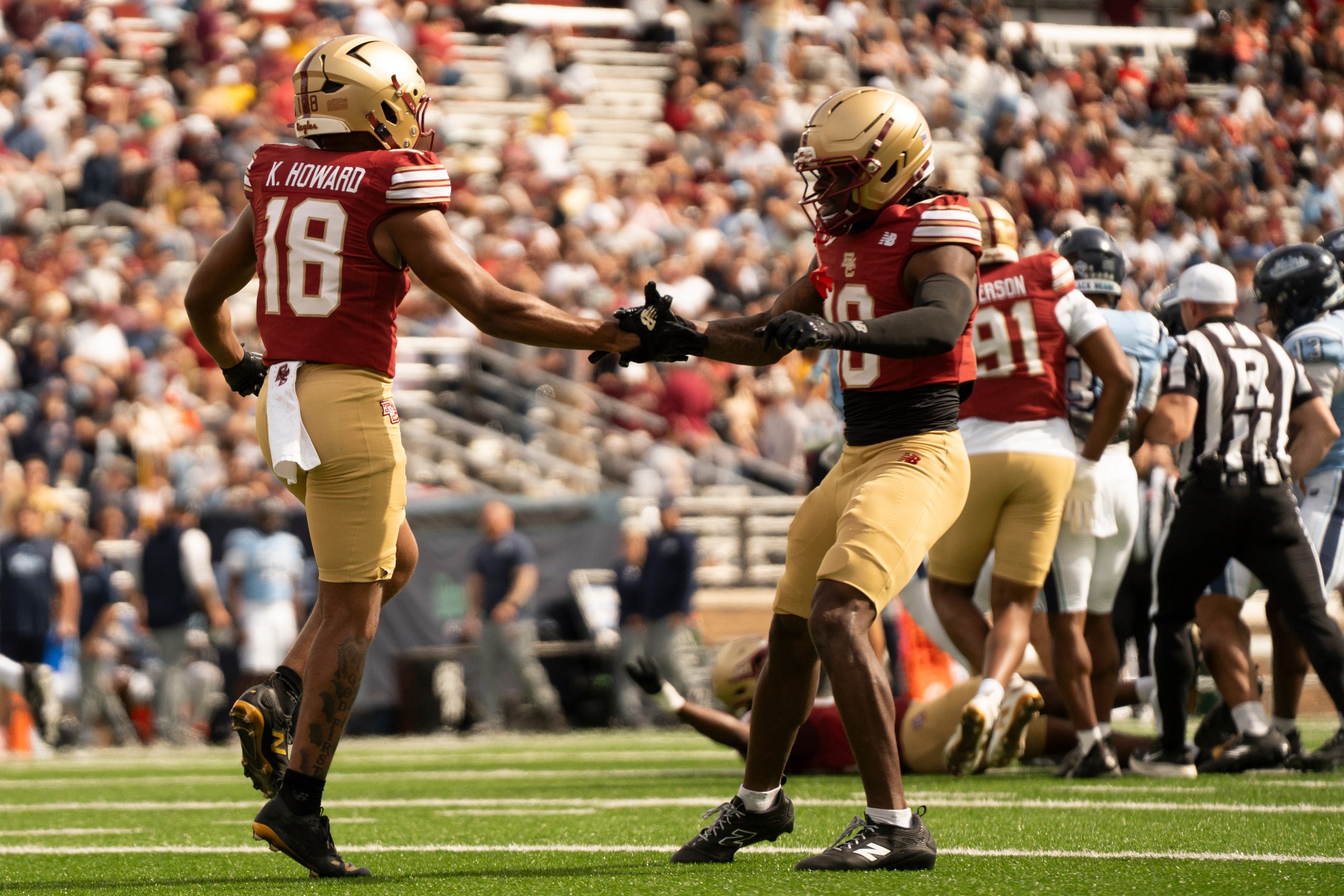
September 19th, 2026 should have been a comfortable afternoon in Chestnut Hill. Coming off an emotional win over Rutgers for the Red Bandanna Game, Boston College had an opportunity to clean things up against Maine before conference play. Instead, the Eagles escaped Alumni Stadium with a 22-16 victory that offered more frustration than confidence.
For the opening quarter, BC appeared ready to handle business. Evan Dickens broke free for a 39-yard touchdown, and a safety followed by a Johnathan Montague Jr. touchdown catch gave the Eagles a comfortable 16-0 lead. However, even that start came with warning signs. The Eagles received the opening kickoff and came away empty, then wasted another opportunity with a failed fourth-down attempt near the goal line.
Those missed chances became uncomfortable as Maine worked its way back. The Black Bears cut the deficit to 19-10 before halftime, while BC managed just three points across the final two quarters. What should have become an opportunity to give younger players meaningful snaps instead became another afternoon spent protecting a narrow lead.
Dickens gave the Eagles’ some productive work on the ground, finishing with 102 rushing yards. Mason McKenzie threw for 173 yards, while former quarterback Jonathan Montague led BC’s receivers with 72 yards. For Maine, Eddie Buehler eclipsed McKenzie with 201 passing yards. The Eagles outgained the Black Bears 359-270, but both teams finished with 18 first downs.
Buehler also connected with receiver Nick Laughlin for both Maine touchdowns, keeping the visiting Maine within striking distance.
The concerns for BC go beyond the final margin. The Eagles converted just four of twelve third downs and failed on both fourth-down attempts. Against an FCS opponent, those are possessions an ACC offense should be extending. Scoring six points after the first quarter only makes those shortcomings harder to dismiss.
With Virginia Tech visiting Alumni Stadium next Saturday, Bill O’Brien has plenty to address. BC needs more consistent quarterback play, better execution in short yardage, and an offense capable of finishing games before the final possession. The Eagles got their second win, but this was a game they should have won by much more. Conference opponents will demand better.

Boston College 14, Virginia Tech 21: Eagles run out of steam as Hokies pull away late

DiMAURO: Note to the BC family: We’re ALL in this together

Boston College 22, Maine 16. Eagles narrowly escape FCS Bears

Boston College Hockey Recruiting Board: 2024-25 Season

Rider: A breath of fresh air

Boston College lands FIU transfer QB Grayson James
-

 Football3 months ago
HUTCHINSON: Bill O’Brien says a rebuilt Boston College and starting quarterback Mason McKenzie are ready for Year 3
-

 Football2 months ago
HUTCHINSON: 2026 Boston College Football Season Preview: Roster Breakdown, Floor, Ceiling and Prediction
-

 Baseball5 months ago
DiMAURO: Birdball’s great season a beacon and a reminder for all other BC programs
-

 Football2 months ago
Boston College Football 2026 Training Camp Notes: Defense sets the tone in Scrimmage No. 2
-

 Football1 month ago
Can Boston College’s defense deliver at Cincinnati? Preview and predictions
-

 Football1 month ago
Twenty-Five Years Later, the Red Bandanna Still Leads the Way: Boston College 28, Rutgers 21
-
 Football1 month ago
DiMAURO: Honoring Welles on Sept. 11 the biggest event in the history of the BC campus
-
 Football3 weeks ago
Boston College 14, Virginia Tech 21: Eagles run out of steam as Hokies pull away late
Olivia Granados Granados
September 14, 2026 at 3:05 am
The most beautiful post I’ve read in a long time. Thank you for continuing to spread Welles legacy and what his sacrifice truly means to people around the world effected by 9/11.